
 Kevin Collins
Startup Strategy Council: Open Source Multi-Agent AI for Strategic Decisions
6 AI advisors that debate your strategic decisions until they reach consensus. Built with Claude Code, open sourced by Echofold.
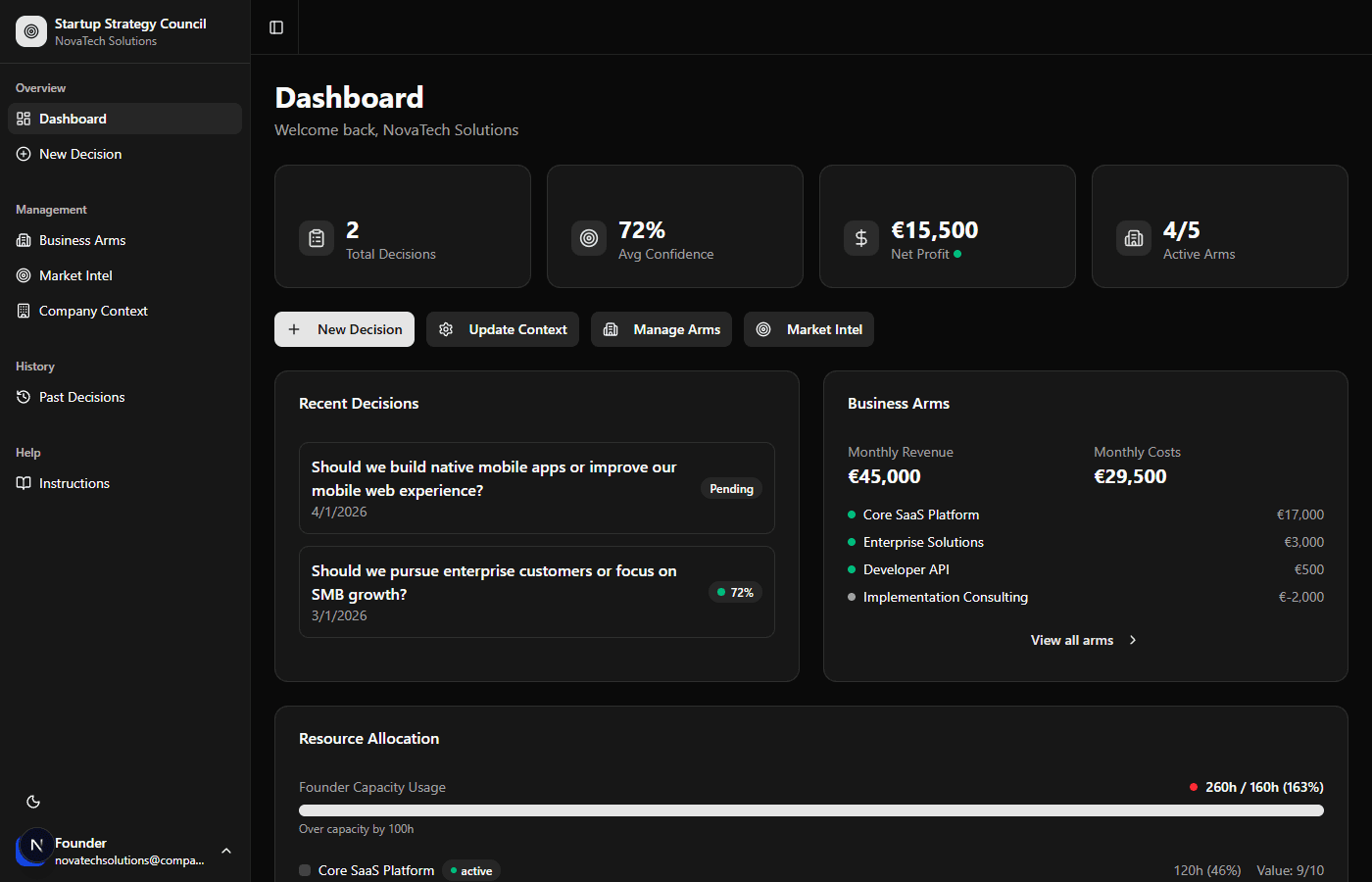
What is Startup Strategy Council?
Startup Strategy Council is an open source multi-agent AI system that simulates having 6 specialised advisors debate your strategic decisions. A Financial Analyst runs ROI numbers, a Market Analyst evaluates positioning, a Risk Analyst identifies what could go wrong, a Game Theorist maps strategic dynamics, a Resource Allocation expert checks bandwidth, and a Chief of Staff synthesises everything. Apache 2.0 licensed.
TL;DR
- •6 AI agents analyse decisions from different business perspectives (financial, market, risk, game theory, resources, synthesis)
- •Agents debate when their scores diverge by 3+ points, challenging each other's reasoning until consensus
- •Open source Apache 2.0, works with Claude CLI (recommended) or OpenAI API
- •Built with Claude Code over a weekend by Kevin Collins (Echofold co-founder)
- •Designed for founders making strategic decisions like pricing, market expansion, and resource allocation
Like most founders, I've accumulated a collection of internal tools that help run the business. Some are scrappy scripts, others are full applications. Most sit in private repos, unseen by anyone outside the team.
One of those tools is a multi-agent AI system I call Startup Strategy Council. It simulates having 6 specialised advisors debate your strategic decisions—a Financial Analyst running ROI numbers, a Market Analyst evaluating competitive positioning, a Risk Analyst identifying what could go wrong, a Game Theorist mapping strategic dynamics, a Resource Allocation expert checking bandwidth, and a Chief of Staff synthesising it all.
The agents don't just give you scores. They actually debate each other. When one rates an option a 9 and another rates it a 4, they challenge each other's reasoning until they reach consensus (or agree to disagree).
I built the entire thing with Claude Code over the weekend. The whole experience reminded me why I fell in love with building software in the first place.
So I'm open sourcing it. Apache 2.0. Works with Claude CLI or OpenAI. Maybe it helps you. Maybe you fork it and build something better. Either way, it shouldn't just sit in a private repo anymore.
01.Meet the Six Advisors
Each agent brings a distinct perspective to your strategic decisions. They're not just generic advisors—each has specific evaluation criteria and challenges the others when their analysis differs.
| Agent | Specialisation | Focus Areas |
|---|---|---|
| Financial Analyst | ROI & Cash Flow | Payback periods, expected value, financial risk exposure |
| Market Analyst | Market Dynamics | TAM/SAM/SOM, competitive positioning, market timing |
| Risk Analyst | Risk Assessment | Execution risk, market risk, technical risk, financial risk |
| Game Theorist | Strategic Dynamics | Nash equilibrium, first-mover advantage, network effects |
| Resource Allocation | Resource Management | Time investment, bottlenecks, delegation opportunities |
| Chief of Staff | Synthesis | Consensus building, dissent tracking, final recommendation |
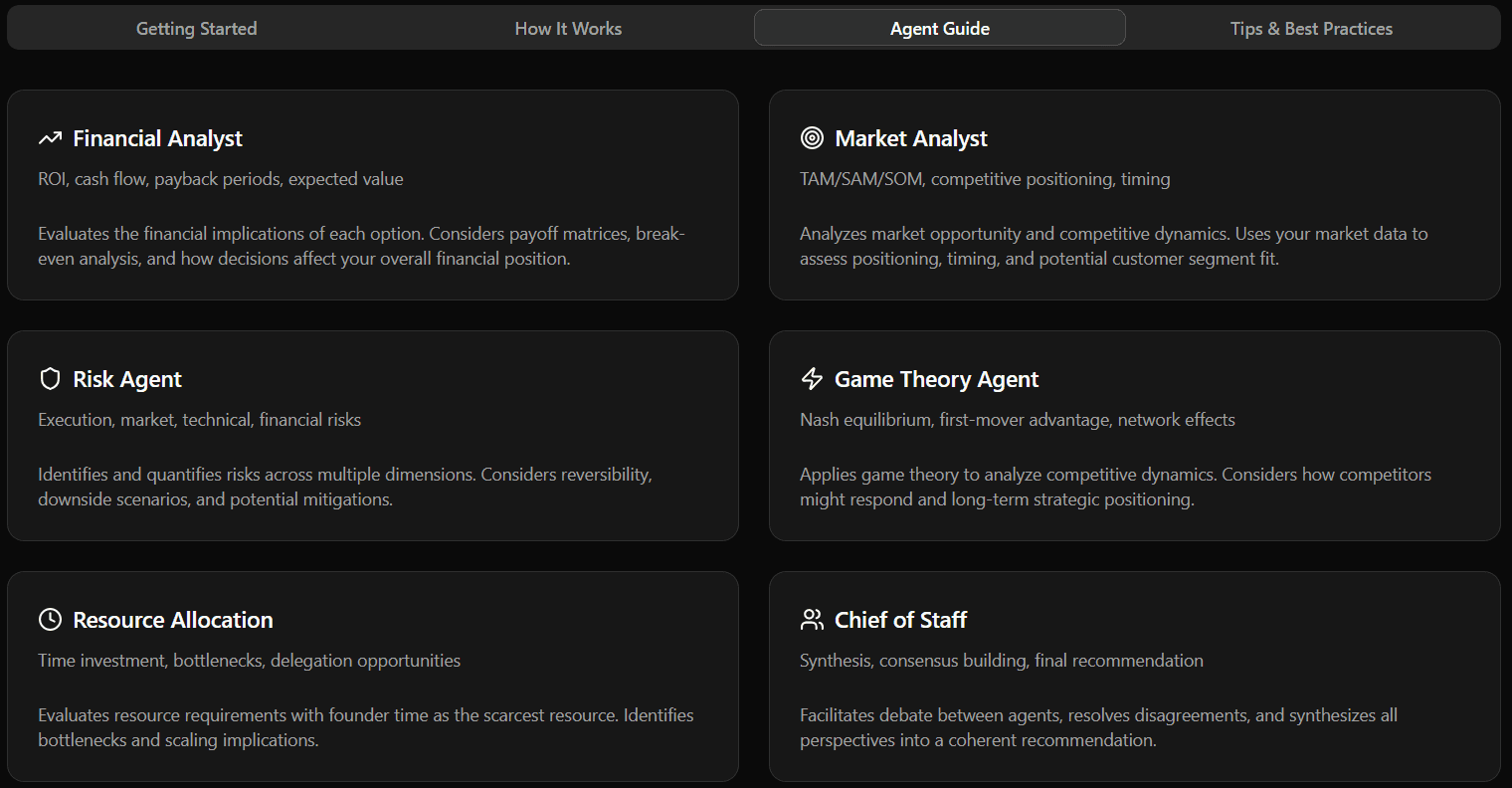
The power isn't in any single agent—it's in their interaction. A Financial Analyst might love an option for its ROI, but the Risk Analyst might flag execution challenges that change the calculus entirely. The Chief of Staff's job is to synthesise these perspectives into actionable recommendations.
02.How the Debate Mechanism Works
The most interesting part of Startup Strategy Council isn't the individual agent analyses—it's what happens when they disagree.
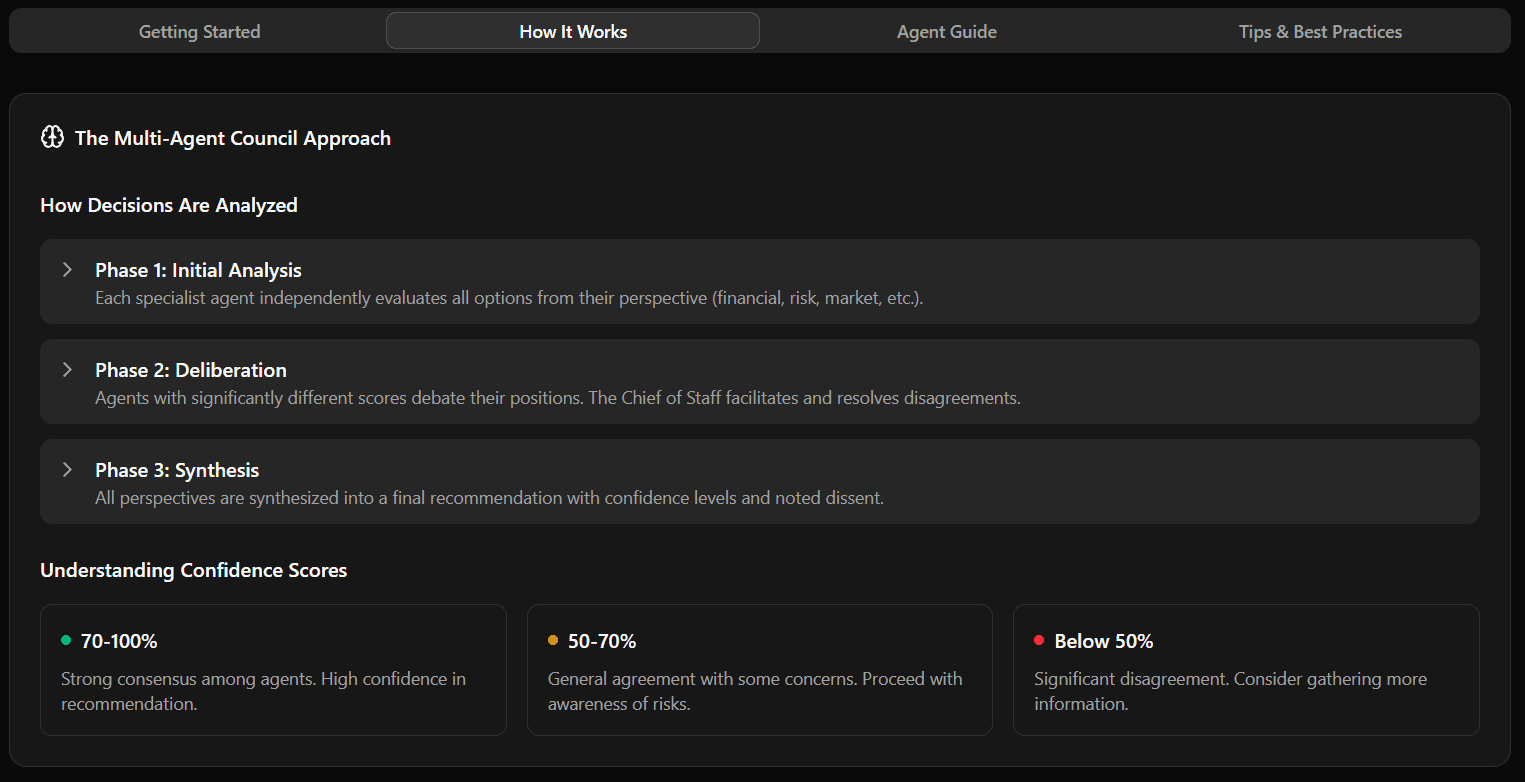
The Deliberation Process
Independent Evaluation
Each agent evaluates your options independently, assigning scores from 1-10 with detailed reasoning.
Divergence Detection
The system identifies when agent scores diverge by 3 or more points—a signal that perspectives differ significantly.
Agent Debate
Disagreeing agents challenge each other's reasoning. The Financial Analyst might question the Market Analyst's growth assumptions.
Consensus or Dissent
Agents either converge on a shared view or formally document their dissent. Both outcomes provide valuable signal.
Why Debate Matters
Traditional AI analysis gives you a single perspective. Even multi-model approaches often just average opinions. The debate mechanism surfaces why perspectives differ—which is often where the most valuable insights hide. A 7/10 with strong consensus is very different from a 7/10 where agents are split 9 vs 5.
03.Getting Started
Startup Strategy Council is designed to be up and running in under 15 minutes. Here's what you need:
Prerequisites
- Node.js 18+ installed on your machine
- Claude CLI installed and authenticated (recommended) OR OpenAI API key
- Git for cloning the repository
Installation Steps
Step 1: Clone the Repository
git clone https://github.com/kevincollinsirl/startup-strategy-council.git
cd startup-strategy-council
Step 2: Install Dependencies
npm installStep 3: Configure Environment
cp .env.example .env.local
# Edit .env.local with your API configuration
Step 4: Start the Development Server
npm run dev
# Visit http://localhost:3000
Once running, you can describe your decision, define 2-4 options with costs and timelines, and let the council analyse and debate. The system stores your company context so subsequent decisions benefit from accumulated knowledge.
04.Practical Use Cases
Startup Strategy Council works best for decisions with multiple viable options and significant trade-offs:
Pricing Strategy
Evaluating pricing tiers, freemium vs premium models, or market positioning through price.
Example: "Should we raise prices 20%, keep them flat, or introduce a new enterprise tier?"
Market Expansion
Deciding between geographic expansion, new verticals, or adjacent markets.
Example: "Expand to UK market, target healthcare vertical, or double down on current segment?"
Resource Allocation
Prioritising where to invest limited engineering, marketing, or capital resources.
Example: "Invest next quarter in product features, sales team, or infrastructure?"
Partnership Evaluation
Assessing potential partners, integration opportunities, or strategic alliances.
Example: "Partner with Platform A, Platform B, or build in-house?"
05.Why Open Source?
I built this tool in a day using Claude Code, and it's already been helping with decisions at Echofold. The question of whether to open source it was, fittingly, one I ran through the council itself.
"Maybe it helps you. Maybe you fork it and build something better. Either way, it shouldn't just sit in a private repo anymore."
The Apache 2.0 License
Startup Strategy Council is licensed under Apache 2.0 with attribution to Echofold. This means you can:
- Use it for personal or commercial projects
- Modify the code and create derivatives
- Distribute modified versions
- Attribution to Echofold (echofold.ai) is required

Your AI Advisory Board Awaits
Building Startup Strategy Council reminded me why I fell in love with building software. The combination of Claude Code's speed, multi-agent architectures, and the sheer utility of having advisors that challenge each other's thinking—it's exactly the kind of tool I wish I'd had earlier in my founder journey.
Clone the repo. Run a decision through it. Fork it and make it better. And if you're building AI tools for founders, reach out—I'd love to see what you create.
Get the Code
Startup Strategy Council is free and open source. Clone the repo and start making better strategic decisions today.